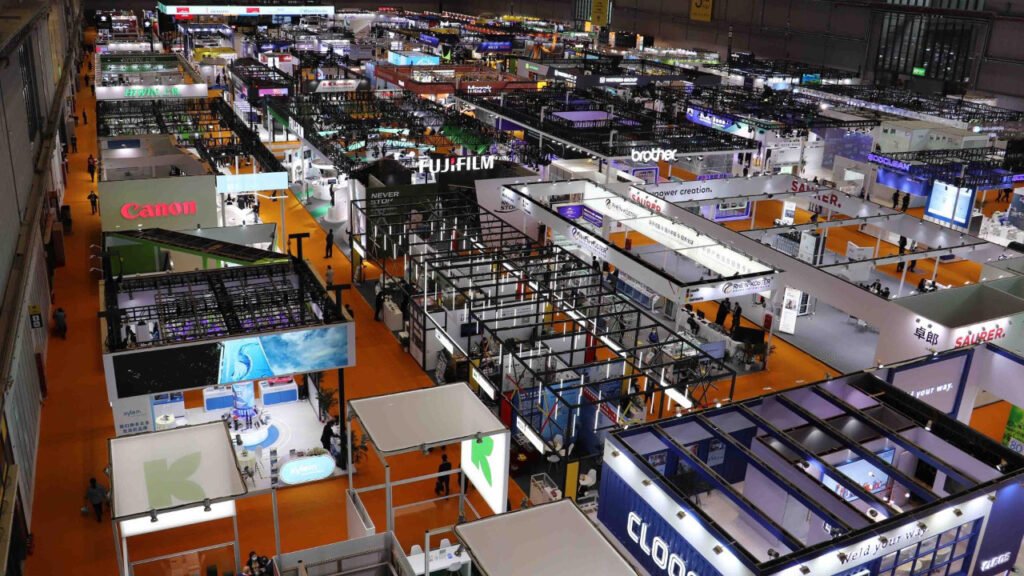
The 8th China International Import Expo (CIIE), which offers significant opportunities for entry into the world’s largest market, took place from November 5–10. The fair, held under the direct support of Chinese President Xi Jinping, aims to connect producers from around the globe with Chinese companies to facilitate the entry of high-quality products into China. A total of 23,000 companies participated, and in the first three days alone, commercial transactions worth 500 billion USD were facilitated.
155 COUNTRIES REPRESENTED
This year’s event, held in Shanghai, hosted 4,108 international participants from 155 countries, breaking a record with its 430,000-square-meter exhibition area.
Turkish products were represented at three separate booths. Organized by the Aegean Exporters’ Associations (EİB), Turkish companies participated with the aim of gaining a larger share of China’s $2.6 trillion import market and enhancing trade relations in the food, consumer goods, and services sectors.
STRONG INTEREST IN TURKISH HAZELNUTS
Turkish companies producing food, textiles, and cosmetics attracted considerable attention at the fair.
İlker Kırcı, Foreign Trade Manager of Altaş Yan Sanayi, representing Çotanak, spoke to Aydınlık about the company and the Chinese market:
“We are a factory producing vegetable oils, primarily known for our hazelnut oil under the Çotanak brand. We also produce sunflower oil, safflower oil, and other vegetable oils. Additionally, we have new product lines such as cocoa hazelnut paste, peanut butter, and roasted hazelnuts—all manufactured in Ordu.
“We also have a chocolate product line. While Dubai chocolate became popular for its pistachio-based production, we created Ordu chocolate using hazelnuts. It’s in high demand—hazelnuts simply suit chocolate better.”
“WE MUST NOT FALL BEHIND IN THE CHINESE MARKET”
Kırcı noted that they had participated in the fair since its inception:
“Until the pandemic, we were expanding our trade with China and even had an office in Shanghai. The pandemic disrupted this, but we are trying to regain momentum. We’ve participated in more than 10 fairs in China overall. It’s a growing market with 1.5 billion people—one we can’t afford to miss.
“We already export safflower oil to China, which is mostly used by health companies. Since raw materials are heavily taxed in Turkey, we import them from Russia and Kazakhstan under the Inward Processing Regime, process them in Turkey, and export to China. If agricultural policies allowed more domestic production, we could export even more.”
“FOOD EXPORTS TO CHINA CAN BE EXPANDED”
Highlighting the significant trade deficit between Turkey and China, Kırcı added:
“Although production costs in China are low, we can increase exports in the food sector. We also import machinery from China—good quality at reasonable prices. But China doesn’t have hazelnuts like Turkey does, for example. One company we met expressed interest in importing Turkish hazelnuts.
“Beyond hazelnuts, we can export apricots, raisins, and other dried fruits and nuts. I’m optimistic. Chinese consumers value reliability and quality, so we must build that trust.”
“PRODUCTS TAILORED FOR CHINA”
Mehmet Sinan Ertek, Asia and Middle East Sales Manager of Venüs Bisküvi, which promoted its products at the fair, said:
“Venüs Bisküvi was founded in 2012 in Bursa. We export to more than 60 countries—mainly to Europe, the Middle East, Asia, and the Americas. This fair is an important opportunity to meet our Chinese partners and explore potential business prospects. Interest in our products has been great; people are often surprised to learn we’re Turkish. It’s a price-sensitive, highly competitive market, but we offer products suited to local preferences.”
Ertek added that they developed special recipes for China:
“For example, our biscuits have less sugar compared to those made for the Turkish market, and we’ve created savory snacks specifically for Chinese consumers. Due to political reasons, some products from the U.S. are no longer available here—so we can be an alternative.
“China has a large population willing to try new and imported products. That’s our target audience. We compete with producers from South Korea, the U.S., Egypt, and local manufacturers—but we aim to stand out with our quality and brand presence.”
“A GLOBAL BRAND FROM TURKEY IN COSMETICS”
Murat Şahin, owner of Yarım İç ve Dış Ticaret, representing the cosmetics sector, said there is a lack of global Turkish brands in cosmetics:
“We’ve served many companies in the cosmetics industry for 15 years, but for the past two years, we’ve focused on developing a global brand that represents Turkey. We already export to Azerbaijan, Dubai, Qatar, Kuwait, Russia, and Ukraine. When considering a new market, we decided on China and joined the fair through the EİB’s organization.
“Preparing for a fair like this isn’t easy—you must conduct months of research to understand local consumer habits. Based on this, we developed a special line of hair and skincare products for the Chinese market.”
Şahin continued:
“Competing with local Chinese producers in terms of cost is nearly impossible. However, as income levels rise, consumption habits change, and consumers gravitate toward higher-quality products. We trust the quality of our products and understand Chinese consumer preferences, so we plan to progress from this point.
“We must differentiate ourselves by building a global brand and creating unique products. Around 300 million Chinese consumers shop online—almost 3.5 times Turkey’s total population.
“China’s purchasing power has risen; high-quality products find buyers. China today is not what it used to be—when I was a student, the minimum wage was about $100; now it’s nearly $1,000.”
Source: https://www.aydinlik.com.tr/haber/turk-is-insanlari-cin-firsatlarinin-pesinde-555052